Rabies Post-Exposure Prophylaxis (PEP) for Returned Travellers — A Comprehensive Canterbury Guide
Specialist Medical Advice for Kiwis Returning from Asia, Africa, and the Americas
Imagine you are enjoying a long-awaited holiday in Bali or trekking through the rural landscapes of Thailand. A stray dog nips your ankle, or a monkey at a popular tourist site scratches your hand during a feeding session. At the time, it might seem like a minor nuisance—a small scratch that barely bleeds. However, if that animal was carrying the rabies virus, that "minor" incident has just become a life-threatening medical emergency.
For New Zealanders returning to Christchurch and the wider Canterbury region, navigating the complexities of rabies treatment can be daunting. New Zealand is a rabies-free country, which means our local healthcare environment is not one where rabies is a daily conversation. Yet, for the thousands of Kiwis who travel to endemic regions every year, the risk is real.
In this guide, Dr. Bernard Teo (Specialist GP at 1 Health Wigram) breaks down exactly what you need to know about Rabies Post-Exposure Prophylaxis (PEP), how to navigate the Canterbury health system, and why you should never assume it’s "too late" to seek help.
1. What is Rabies and Why Is It So Dangerous?
Rabies is a severe viral infection of the central nervous system caused by the rabies lyssavirus. It is primarily transmitted through the saliva of an infected animal via bites, scratches, or licks on broken skin or mucous membranes.
The most terrifying aspect of rabies is its mortality rate. Once clinical symptoms appear—such as hydrophobia (fear of water), agitation, or paralysis—the disease is almost 100% fatal. Worldwide, rabies still claims approximately 59,000 lives every year, with the vast majority of these deaths occurring in Asia and Africa.
Fortunately, rabies is entirely preventable through a medical protocol known as Post-Exposure Prophylaxis (PEP). If administered correctly and promptly after exposure, the treatment is nearly 100% effective at stopping the virus before it reaches the brain.
2. High-Risk Destinations: The "Kiwi Connection"
Many of the most popular travel destinations for New Zealanders are rabies-endemic. If you have recently returned from any of the following regions and had animal contact, you should seek a professional assessment:
- South and Southeast Asia: This includes Bali (Indonesia), Thailand, Vietnam, the Philippines, and India. India alone accounts for roughly 35% of global rabies deaths.
- Africa: Particularly Sub-Saharan regions and North African countries like Morocco.
- Latin America: Rural areas in Central and South America.
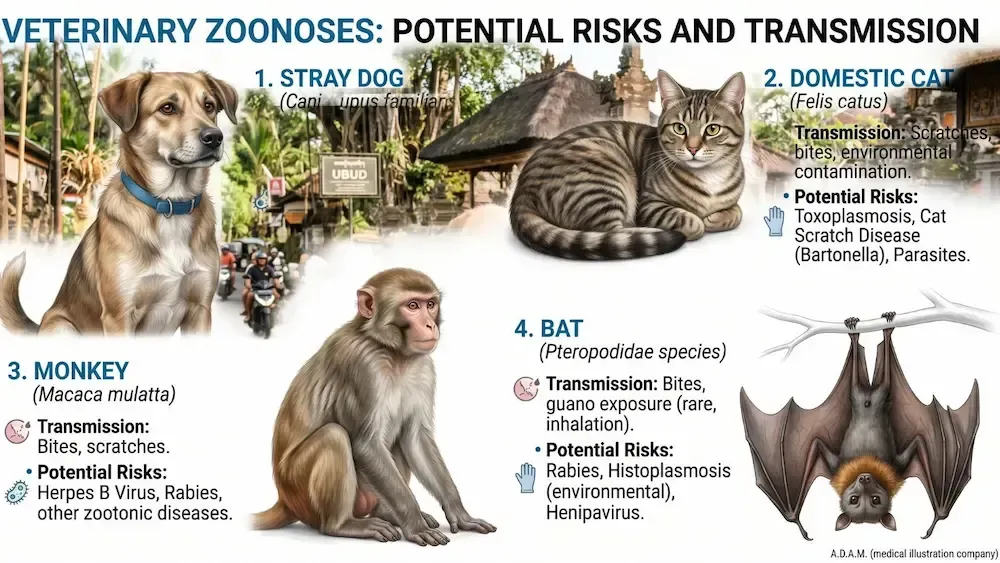
While dogs are responsible for 99% of human transmissions, travellers should also be wary of cats, monkeys, and bats. In Bali and Thailand, monkey "exposures" are incredibly common at temples and tourist parks, while cat scratches are frequently reported by travellers in North Africa.
3. Understanding WHO Exposure Categories
Not every animal interaction requires a full course of vaccines. The World Health Organisation (WHO) classifies exposures into three categories to determine the necessary treatment:
| Category | Type of Contact | Required Treatment |
|---|---|---|
| 1 | Touching/feeding animals; licks on intact skin. | None. Wash the area with soap and water. |
| 2 | Minor scratches or nibbling of uncovered skin (no bleeding). | Immediate wound washing + Rabies Vaccine course. |
| 3 | Single/multiple bites or scratches; saliva on mucous membranes; any bat contact. | Immediate wound washing + Rabies Vaccine + Rabies Immunoglobulin (RIG). |
Important Clinical Note: Bites or scratches on the head, neck, face, hands, or fingers are automatically treated as Category III. These areas have a high density of nerves, which allows the virus to travel to the brain more rapidly.
4. The 15-Minute Rule: Immediate First Aid
If you are bitten or scratched while overseas, the single most important thing you can do is immediate wound care.
- Vigorous Washing: Scrub the wound with soap and running water for at least 15 minutes. This mechanical action significantly reduces the viral load at the site of the injury.
- Antiseptic Application: Apply povidone-iodine (Betadine), iodine, or 70% alcohol to the wound after washing.
- Seek Medical Care Abroad: Start the PEP process immediately in the country where you are located. Do not wait until you return to New Zealand to begin the first dose of the vaccine.
5. What is Post-Exposure Prophylaxis (PEP)?
PEP is a dual-action treatment designed to "race" the virus. It consists of:
The Rabies Vaccine
The vaccine stimulates your own immune system to produce antibodies. For someone who has never been vaccinated (immunologically naïve), the standard course involves four intramuscular (IM) injections given on days 0, 3, 7, and 14–28.
Rabies Immunoglobulin (RIG)
For severe (Category III) exposures, the vaccine alone may not work fast enough. RIG provides "passive" protection—it contains ready-made antibodies that are injected directly into and around the wound to neutralize the virus instantly while the vaccine kicks in.
The 7-Day Window: Critically, RIG must be administered within 7 days of the first vaccine dose. After this point, it is no longer effective because the body has likely started producing its own antibodies.

6. The Canterbury Health Pathway: Returning to Christchurch
If you started your treatment overseas or were bitten just before boarding your flight home, 1 Health in Christchurch is your local partner in completing your PEP.
Step 1: Expert Assessment
Our team, led by Dr. Bernard Teo, will review your travel history, the type of animal involved, and any treatment you received abroad. We work closely with the Canterbury Infection Management Service to ensure you are following the most up-to-date local health protocols.
Step 2: Sourcing the Vaccine
Rabies vaccines are not kept as standard stock in every GP clinic. However, 1 Health can source and provide the vaccine at short notice. It is essential to bring any records of previous doses (batch numbers and dates) from your time overseas.
Step 3: Accessing RIG (Rabies Immunoglobulin)
RIG is notoriously difficult to find in many developing countries; studies show fewer than 20% of travellers who need it actually receive it abroad. In Canterbury, RIG is supplied by the New Zealand Blood Service and can be administered via the Christchurch Hospital Infection Management Service or the Emergency Department. We can assist in the referral and sourcing process to ensure you get this life-saving shield if you missed it overseas.
7. Who Pays? ACC and Travel Insurance
A common concern for returned travellers is the cost. Rabies PEP is not funded or subsidized by the Ministry of Health, meaning patients generally pay for the vaccines upfront.
However, there are two major ways to recover these costs:
- ACC (Accident Compensation Corporation): In New Zealand, an animal bite is considered an "accident." We will complete an ACC claim form on your behalf during your first assessment. Most patients can have their vaccine costs reimbursed under ACC’s preventative treatments policy.
- Travel Insurance: Most comprehensive policies cover rabies treatment. Ensure you keep every receipt and medical note from your treatment both overseas and in New Zealand.
8. "It’s Been Three Weeks—Is It Too Late?"
A dangerous myth is that if you didn't get treated immediately, there is no point in doing it now. This is false.
The incubation period for rabies is highly variable—it typically takes 3 to 8 weeks, but cases have been recorded where symptoms appeared months or even years later. PEP is effective as long as it is started before the onset of symptoms. Even if your exposure was weeks ago, you should still seek medical attention immediately.
9. Why Pre-Travel Vaccination (PrEP) is the "Gold Standard"
If you are planning a trip to a high-risk area, we strongly recommend Pre-Exposure Prophylaxis (PrEP). This usually involves two doses given on day 0 and day 7.
Why get vaccinated BEFORE you go?
- No RIG Needed: If you are bitten, you never need Rabies Immunoglobulin, which is the hardest part of the treatment to find and the most expensive.
- Fewer Shots: Your post-exposure treatment drops from four doses down to just two.
- Buys You Time: It provides a safety net if you are in a remote area and can't reach a major hospital within 24 hours.
10. When to Seek Urgent Help (The Red Flags)
Go to the Christchurch Hospital Emergency Department or call 111 immediately if you develop any of these symptoms following an animal bite overseas:
- Fever, headache, or tingling at the site of the original wound.
- Confusion, agitation, or difficulty swallowing.
- Muscle spasms or paralysis.
Trust the Experts at 1 Health Wigram
At 1 Health, we are committed to providing world-class travel medicine care right here in Christchurch. Whether you need a final vaccine dose to complete your course or an urgent assessment after a recent trip, we are here to help.
Time matters with rabies. Don’t delay. Contact us Today!
Have Questions About Your Health?
Our clinicians at 1 Health are here to help — whether it’s GP care, dental, travel vaccines, or facial aesthetics. Book a consultation anytime.
Book Online:
https://www.1health.nz/contact
Call:
Disclaimer:
This article is for general information only and is not medical advice. Every person’s health situation is different. For personalised guidance or diagnosis, please consult a qualified clinician.