The Summer Skin Audit: Why You Need a Dermoscopy Mole Check Before 2026

Bernard Teo • 14 December 2025

New Zealand has the highest rate of melanoma in the world. It is a statistic we hear often, but it hits harder when summer arrives, the layers come off, and we notice spots on our skin that weren't there last year.


Mid-December is the busiest time of year for our clinic—not just for travel vaccines, but for patients concerned about "that weird mole on my shoulder."


At 1 Health, we believe that early detection is the only defence that matters. But not all skin checks are created equal. In this guide, we explain the difference between a quick glance and a medical-grade Dermoscopy check, and why "waiting to see if it grows" is the wrong strategy.


The "Ugly Duckling" Rule: What to Look For

Most of us know the ABCDE rule for melanoma (Asymmetry, Border, Colour, Diameter, Evolving). However, the most effective way to spot a problem early is often the "Ugly Duckling" sign.

Most of your moles will look like "siblings"—they will have a similar shape, colour, and style. If you have one mole that stands out—it’s darker, redder, or just looks different from the rest—that is your Ugly Duckling. It demands immediate professional attention.


Common Summer Warning Signs:

  • New Moles: Developing new moles after age 40 is less common and should be checked.
  • The "Pimple" That Won't Heal: A sore that bleeds, scabs, and heals but then bleeds again is a classic sign of Basal Cell Carcinoma (BCC).
  • Itchy or Tender Spots: Moles shouldn't hurt. If one does, get it checked.


Why the "Naked Eye" Isn't Enough

Many patients ask, "Can't I just keep an eye on it myself?"

The problem is that by the time a melanoma is clearly visible to the naked eye as a "dangerous mole," it may have already grown deep into the skin layers.


At 1 Health, Dr. Bernard Teo (who holds a postgraduate Diploma in Dermatology and Skin Cancer Surgery) uses Dermoscopy for every skin check.


What is Dermoscopy?

A dermatoscope is a specialised medical lens that combines magnification with polarized light. It allows us to look through the surface reflection of the skin and visualize the pigment structures underneath.

Think of it like looking at a frozen lake. With the naked eye, you just see the ice (surface skin). With a dermatoscope, we can see what is happening in the water below (blood vessels, pigment networks, and chaotic structures). This technology increases the accuracy of melanoma diagnosis significantly compared to visual inspection alone.
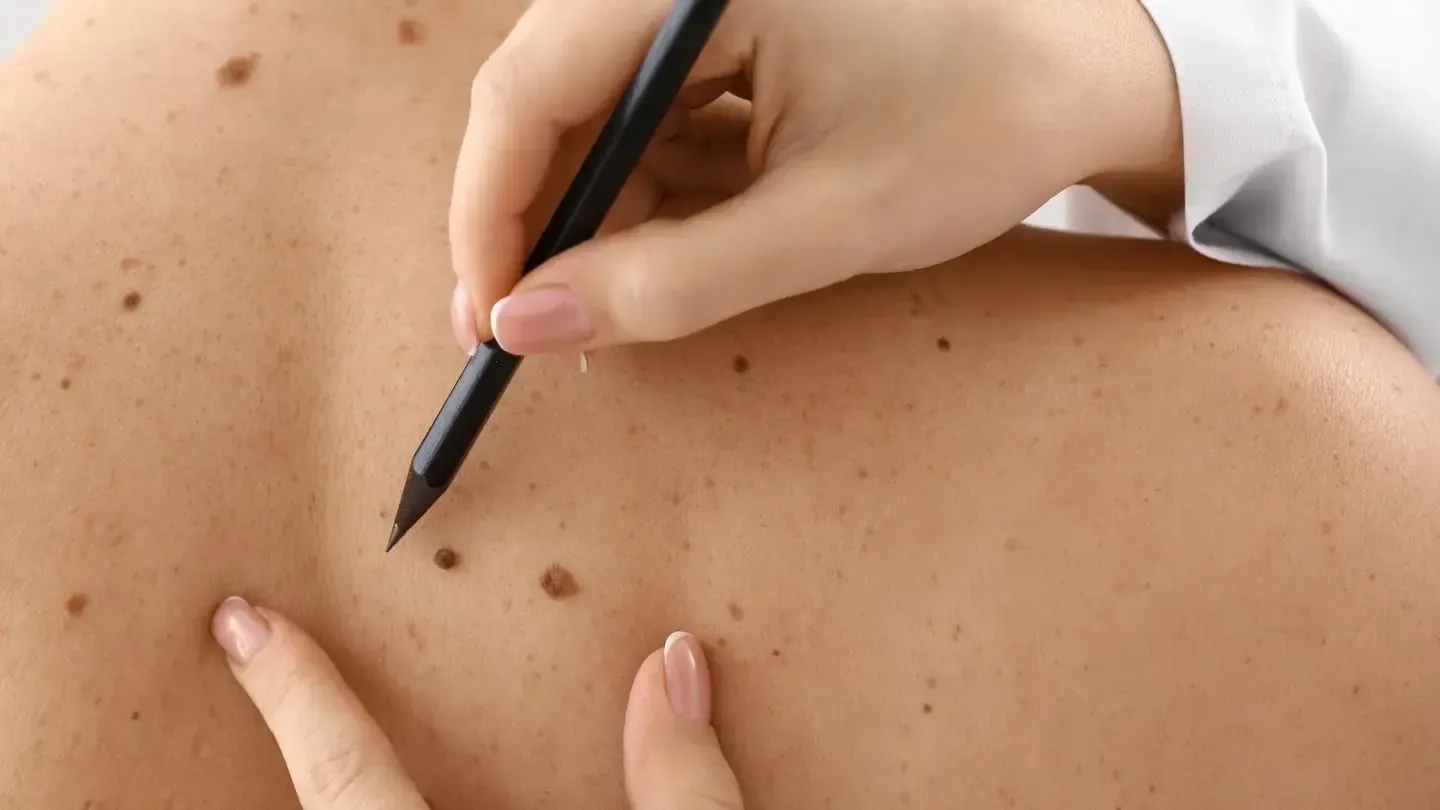


A doctor examining a person's back, using a pen to mark moles.

What Happens at a Skin Check Appointment?

If you have never had a full skin check, it can feel daunting. Here is exactly what happens at our Wigram clinic:


1. The History We assess your risk profile. Have you had bad sunburns in the past? Do you have a family history of skin cancer? Are you on medication that suppresses your immune system?

2. The Scan You will undress down to your underwear (modesty is always preserved). The doctor will systematically check your skin from head to toe, including hidden areas like the scalp, behind the ears, and between the toes.

3. The Diagnosis If we find a suspicious lesion, we look closer with the dermatoscope.

  • Green Light: It is benign (harmless). We can offer reassurance.
  • Amber Light: It looks atypical. We may recommend monitoring it for 3 months or performing a Punch Biopsy to test a small sample.
  • Red Light: It has features of skin cancer. We will recommend Excision (removal).


What If We Find Something? (Don't Panic)

The benefit of coming to 1 Health—rather than a "mole map" photography service—is that we can treat you right here. We are a Minor Surgery center.


If a mole needs removing, you don't need a referral to a hospital.


  • Excision: We numb the area and remove the mole with a safety margin.
  • Histology: Every single lesion we remove is sent to the laboratory for analysis to confirm the diagnosis.
  • Cosmetic Closure: Dr. Teo uses advanced suturing techniques (like elliptical closures or flaps) to ensure the scar is as minimal as possible.


Read more about our surgical techniques in our Guide to Skin Lesion Excisions.


Prevention: The Best Medicine

While we are here to treat you, we would prefer to see you healthy. This summer, remember the basics:


  • SPF 50+: Apply it 20 minutes before you go out, not when you are already at the beach.
  • Timing: The NZ sun is harshest between 10 am and 4 pm.
  • Cover Up: A hat and sunglasses are non-negotiable in Canterbury.


Start 2026 with Peace of Mind

Skin cancer is highly treatable when caught early. Don't let a nagging worry ruin your summer holiday.

Contact 1 Health today to book your Full Body Skin Check. It takes 15 minutes, but it could save your life.

Have Questions About Your Health?

Our clinicians at 1 Health are here to help — whether it’s GP care, dental, travel vaccines, or facial aesthetics. Book a consultation anytime.


Book Online:

https://www.1health.nz/contact


Call:

03 662 9309


Disclaimer:

This article is for general information only and is not medical advice. Every person’s health situation is different. For personalised guidance or diagnosis, please consult a qualified clinician.
Close-up of a person's ear, with hand cupped near to it; gray background.
by Bernard Teo 14 December 2025
Suffering from blocked ears? We offer professional Ear Microsuction (the gold standard) in Wigram. Safe, water-free, and effective ear wax removal. Book today.
Pink background with a white IUD surrounded by pink flowers and confetti.
by Bernard Teo 9 December 2025
Looking for long-term contraception? Compare Mirena (5 years) and Jaydess (3 years). Expert insertion and removal services available at 1 Health Wigram.
Person scratching arm with a rash, wearing a white t-shirt.
by Bernard Teo 9 December 2025
Have a soft lump under your skin? It might be a lipoma. We offer expert assessment and surgical removal (excision) at 1 Health Wigram. Minimal scarring.
Woman in white robe looking in mirror, touching face with fingers.
by Bernard Teo 9 December 2025
Persistent lump on your eyelid? It might be a Chalazion. We offer expert assessment and Incision & Curettage removal surgery at 1 Health Wigram. No referral needed.
Arm with a contraceptive implant visible beneath the skin, held between two fingers against a pink background.
by Bernard Teo 8 December 2025
Looking for long-term contraception? The Jadelle implant offers 99% effectiveness for up to 5 years. Book your insertion consultation at 1 Health Wigram.
Woman sitting outdoors, touching her foot, wearing black pants and sandals; sunny day.
by Bernard Teo 8 December 2025
Suffering from painful ingrown toenails? We offer expert assessment and permanent surgical solutions (Wedge Resection) at 1 Health Wigram. Book today.
Doctor examining a patient's shoulder with a dermatoscope; medical setting.
by Bernard Teo 8 December 2025
A complete guide to skin lesion assessment, surgical removal, and aftercare. Learn about dermoscopy, IV sedation options, and recovery at 1 Health Wigram.
Woman with closed eyes, hands framing face. Wearing white robe, neutral background.
by Simon Mullinger 25 November 2025
1 Health Wigram launches medical-grade facial aesthetics on Dec 1. From anti-wrinkle injectables to Rejuran skin boosters, discover our doctor-led approach to natural rejuvenation.
Two women smiling, sitting at a cafe table, holding coffee cups. Natural light illuminates the setting.
by Bernard Teo 25 November 2025
Refer a friend to 1 Health Aesthetics and earn $50 credit. Plus, they get 20% off their first treatment. Terms and conditions apply.
Aerial view of a sand spit between turquoise waters, with palm trees and a forested shoreline.
by Bernard Teo 24 November 2025
Planning an adventure through Southeast Asia? From the street food of Bangkok to the rice paddies of Vietnam and the beaches of Bali, this region offers unforgettable experiences for Kiwi travellers. However, nothing ruins a holiday faster than a preventable illness. At 1 Health in Wigram , we want you to come home with photos and memories, not a tropical disease. We have condensed the complex medical guidelines into this simple guide for Christchurch locals heading to Southeast Asia. The "Must-Consider" Vaccines While every itinerary is different, these are the most common risks for New Zealanders travelling to countries like Indonesia, Thailand, Vietnam, Cambodia, and Laos. 1. Hepatitis A (The "Food & Water" Risk) Hepatitis A is one of the most common travel-related diseases. It is a viral infection affecting the liver, spread through contaminated food and water. The Risk: You can pick this up even in 5-star resorts, usually through ice cubes, salads washed in tap water, or uncooked shellfish. The Protection: One dose gives you protection for up to a year (covering your trip). A second booster dose 6–12 months later can give you protection for 20+ years. Availability: We stock this on-site at 1 Health. 2. Typhoid Fever Like Hepatitis A, Typhoid is a bacterial infection spread through contaminated food and water. It causes severe fever and stomach pain. The Risk: Higher in areas with poor sanitation, but present throughout Southeast Asia. The Options: You can choose between a single injection (lasts ~3 years) or a course of oral capsules (lasts ~5 years). Timing: The injection needs 2 weeks to work; the capsules need to be finished 10 days before you fly. 3. Japanese Encephalitis (The "Mosquito" Risk) This is a viral infection spread by mosquitoes, primarily in rural agricultural areas (like rice paddies). Who needs it? If you are staying in major cities or beach resorts for a short time, the risk is low. However, if you are planning rural trekking, staying longer than a month, or backpacking through the countryside, this vaccine is strongly recommended. The Protection: Two doses are required (spaced 28 days apart, though an accelerated 7-day schedule is available for last-minute travellers). 4. Rabies (The "Animal" Risk) Southeast Asia has a high prevalence of rabies in stray dogs, monkeys, and bats. It is almost always fatal if untreated. Why vaccinate beforehand? "Pre-exposure" vaccination doesn't make you immune, but it buys you crucial time. If you are bitten, you will need fewer emergency injections, and—crucially—you won't need "Rabies Immunoglobulin" (a blood product that is often unavailable in remote parts of Asia). Who needs it? Cyclists, runners, wildlife volunteers, and children (who are more likely to touch animals) should seriously consider this.